
Use this guide to prepare for the exam, and refer to the official manual for complete details.
Adopting safe driving practices is the most effective way to prevent crashes and protect lives. While knowing the traffic laws is essential, defensive driving goes a step further by teaching drivers to anticipate and react to potential hazards, including the mistakes of others and poor road conditions. Mastering these skills is not only crucial for the road test but forms the foundation of a lifetime of safe driving, reducing risk for the driver, passengers, and everyone else on the road.
Principles of Defensive Driving
Defensive driving is a proactive approach that aims to reduce risk by anticipating dangerous situations. It involves constantly assessing the driving environment and making adjustments to maintain a safe buffer from potential threats. The core principles are scanning, maintaining a space cushion, and managing blind spots.
Scanning
This is the practice of continuously moving one’s eyes to keep track of the entire driving scene. A defensive driver does not just stare at the vehicle directly ahead. They look 10-15 seconds down the road to see potential hazards early. They check their rearview and side mirrors every 5-8 seconds to be aware of traffic behind and to the sides. They also scan for pedestrians, bicyclists, and intersecting traffic before entering any intersection.
Space Cushions
A space cushion is the safe area of open space maintained around a vehicle. This buffer provides the time and distance needed to react to a sudden stop or swerve from another driver. The primary method for judging a safe following distance is the “three-second rule.” A driver should pick a fixed object on the road (like a sign or an overpass) and start counting “one-one-thousand, two-one-thousand, three-one-thousand” when the vehicle ahead passes it. If the driver’s own vehicle reaches the object before finishing the count, they are following too closely. In poor weather, at night, or when following large trucks or motorcycles, this should be increased to a four-second rule or more.
Managing Blind Spots
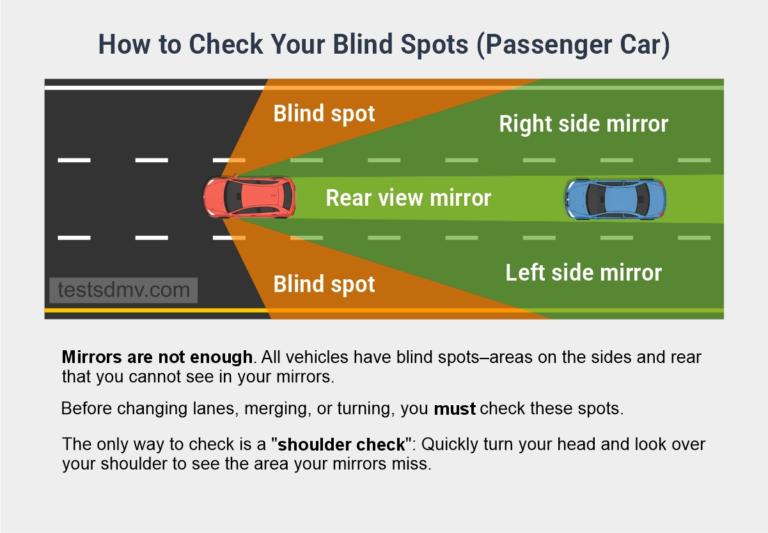
Blind spots are the areas around a vehicle that cannot be seen in the mirrors. Before changing lanes, turning, or merging, a driver must physically turn their head to look over their shoulder to check these areas. It is equally important to manage the blind spots of other vehicles. A driver should avoid lingering in another vehicle’s “no-zone,” especially those of large trucks and buses. If a driver cannot see the truck’s side mirrors, the truck driver cannot see them.
🔒
This is Premium content. Get access to restricted content — extended DMV Tests, Study Guides, and CDL exams.
Get Premium AccessAlready purchased? Log in


