
Road signs in the United States are standardized so that drivers can easily navigate regardless of the state they are in. Understanding the shape and color of a sign allows you to recognize its meaning even before reading the text or identifying the symbol.
Below are the main categories of signs you will encounter on American roads.
Colors and Shapes: The Alphabet of the Road
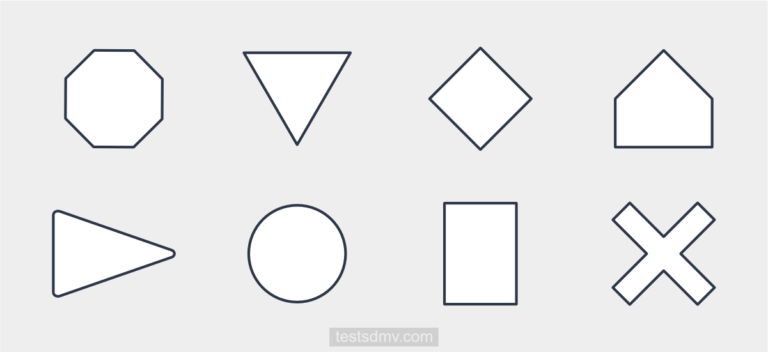
Before looking at specific signs, it is important to understand the meaning of their shapes and colors:
Octagon (Red)
Always indicates a STOP sign and requires a complete stop.
Inverted Triangle (Red/White)
Indicates a YIELD sign. You must give the right of way.
Diamond (Yellow)
Warns of hazards or changes in road conditions ahead.
Pentagon (Yellow/Fluorescent)
Indicates school zones or school crossings.
Pennant (Yellow, on the left side)
Marks the beginning of a no passing zone.
Circle (Yellow)
Warns of an upcoming railroad crossing.
Rectangle (Vertical or Horizontal)
Used for regulatory, warning, and guide signs. The meaning depends on the sign’s color and content.
Common Sign Colors

- Red → Stop, yield, or prohibition
- White → Regulatory signs (rules you must follow)
- Yellow → General warnings
- Fluorescent Yellow-Green → School zones and pedestrian crossings
- Orange → Construction and work zones
- Green → Directions and navigation
- Blue → Services (gas, food, lodging, hospitals)
- Brown → Recreation, parks, and cultural sites
Pro Tip: Yellow vs Orange Signs
These colors indicate different types of conditions.
- Yellow signs → Permanent road conditions.
- Orange signs → Temporary conditions like construction.
Exam trap:
If the question mentions road work or temporary hazards, the correct answer usually relates to orange signs.
Regulatory Signs
These signs inform you of traffic laws and regulations. They are usually rectangular, white with black or red lettering/symbols. Obeying them is mandatory.
STOP SIGN

You must come to a complete stop before the stop line or intersection. Yield to pedestrians and other vehicles, and proceed only when it is safe to do so.
ALL WAY STOP

All approaches must stop before proceeding. Drivers take turns moving through the intersection, typically in the order they arrived.
YIELD SIGN

Slow down and yield the right of way to other vehicles and pedestrians. Stop if necessary for safety, and proceed only when the way is clear.
Pro Tip: STOP vs YIELD
Both signs control right-of-way, but the required action is different.
- STOP → Always come to a complete stop.
- YIELD → Slow down and stop only if necessary.
Exam trap:
Even if the road is clear, you must still fully stop at a STOP sign.
NO TURN ON RED

Right turn on red is prohibited. You must wait for the green signal before making a turn, even if the way is clear.
LEFT TURN YIELD ON GREEN

Left turns must yield to opposing traffic. You may turn left only when there is a safe gap in oncoming vehicles and no pedestrians are crossing.
Pro Tip: NO TURN ON RED vs Right Turn on Red Rule
Right turn on red is usually allowed, but with conditions.
- NO TURN ON RED → Turning right on red is prohibited.
- No sign → Turn is allowed after a full stop, if safe.
Exam trap:
Do not assume right turn on red is always allowed.
NO U-TURN

U-turns are prohibited at this location. Continue to the next safe and legal place if you need to change direction.
NO LEFT TURN

Left turns are prohibited at this intersection. Drivers must continue straight or choose another route.
NO RIGHT TURN

Right turns are prohibited at this location. You must proceed in another permitted direction.
KEEP RIGHT

Vehicles must keep to the right of a divider, island, or obstruction. Pass the object on the right side unless otherwise directed.
SPEED LIMIT

The maximum allowable speed under ideal conditions. Drivers must adjust their speed based on traffic, road, and weather conditions and may need to drive slower when conditions are not ideal.
Pro Tip: Speed Limit vs Advisory Speed
Not all speed signs have the same meaning.
- Speed Limit → Legal maximum speed.
- Advisory Speed (yellow sign) → Recommended safe speed.
Exam trap:
Advisory speeds are not strict legal limits, but ignoring them may be considered unsafe.
NO PASSING ZONE (Pennant)

Indicates that passing is not allowed in this area. This sign is placed on the left side of the road and marks the beginning of a no-passing zone.
DO NOT PASS

Passing other vehicles is prohibited in this area. Stay in your lane and do not overtake other vehicles until it is safe and permitted.
DO NOT ENTER

Entry is prohibited. This sign marks areas where vehicles must not proceed, such as one-way streets in the opposite direction or highway exit ramps.
WRONG WAY

You are driving against traffic. Stop immediately, do not continue forward, and turn around when it is safe to do so.
Pro Tip: DO NOT ENTER vs WRONG WAY
These two signs often appear together, but they mean different things.
- DO NOT ENTER → You are about to enter a restricted road from the wrong direction.
- WRONG WAY → You are already driving against traffic.
Exam trap:
If the situation shows you already on the road facing traffic, the correct answer is WRONG WAY, not DO NOT ENTER.
Warning Signs
These signs warn of potential hazards. They are almost always yellow diamonds with black symbols.
Roadway Changes
MERGING TRAFFIC

Be prepared for other vehicles entering your lane. Adjust your speed and position to allow safe merging.
LANE ENDS

The lane is ending, and you must merge into the adjacent lane. Look for a safe gap and merge smoothly.
TRAFFIC SIGNAL AHEAD

Traffic signal ahead. Be prepared to slow down or stop if the light changes.
TWO-WAY TRAFFIC AHEAD

The road changes from one-way to two-way traffic. Stay to the right and watch for oncoming vehicles.
CURVE SPEED ADVISORY

Indicates a recommended safe speed for a curve ahead. Slow down to maintain control while turning.
ROUNDABOUT AHEAD

A circular intersection is ahead. Be prepared to slow down and yield to traffic already in the roundabout.
CROSSROAD

A four-way intersection is ahead. Watch for traffic from all directions and be ready to yield if necessary.
SIDE ROAD

A smaller road enters from the left or right. Watch for vehicles entering or crossing your path.
HILL

A steep incline or decline is ahead. Adjust your speed and be prepared for limited visibility over the crest.
LOW CLEARANCE

The height clearance ahead is limited. Taller vehicles must use caution or find an alternate route.
ANIMAL CROSSING

Wildlife or livestock may enter the roadway. Reduce speed and be alert, especially in rural areas.
Alignment, Curves and Hazardous Areas
LEFT CURVE
A gradual curve to the left is ahead. Reduce speed and follow the curve safely.
RIGHT CURVE

A gradual curve to the right is ahead. Slow down and maintain control while turning.
SHARP LEFT TURN

A sharp turn to the left is ahead. Significantly reduce speed before entering the turn.
SHARP RIGHT TURN

A sharp turn to the right is ahead. Slow down well in advance to navigate the turn safely.
WINDING ROAD

A series of curves ahead. Adjust speed and be prepared for multiple changes in direction.
SLIPPERY WHEN WET (Car Skidding)

The road may become slippery when wet. Reduce speed and avoid sudden braking or sharp turns.
Surface and Road Conditions
BUMP

A sudden bump in the roadway is ahead. Slow down to maintain control and avoid vehicle damage.
DIP

A dip or low area in the roadway is ahead. Reduce speed to pass through it safely.
ROUGH ROAD

The road surface is uneven or in poor condition. Slow down and be prepared for a less stable ride.
NARROW BRIDGE

The bridge ahead is narrower than the roadway. Slow down and be prepared to share limited space with other vehicles.
Schools and Pedestrians
Fluorescent yellow-green is often used for these signs to increase visibility.
SCHOOL ZONE

Indicates an area near a school where children may be present. Reduce speed, watch for pedestrians, and be prepared to stop when necessary.
Pro Tip: School Bus vs School Zone Signs
These signs have very different levels of importance.
- School Bus (red flashing lights) → You must stop.
- School Zone sign → Slow down and watch for children.
Exam trap:
Only the school bus requires a mandatory stop in all cases.
PEDESTRIAN CROSSING (Walking Person)

Indicates a location where pedestrians may cross the roadway. Slow down, watch carefully for people crossing, and yield the right of way when necessary.
Railroad Crossings
Railroad crossings require special attention due to the risk of trains.
RR WARNING SIGN (CIRCLE)

Indicates that you are approaching a railroad crossing. Slow down and be prepared to stop if a train is coming.
CROSSBUCK SIGN

Placed at the tracks and marks the exact location of the crossing. Drivers must yield to any approaching train and stop if necessary.
Work Zone Signs
Work zones are areas where road construction or maintenance is taking place. They are marked by orange signs, as well as cones, barrels, and temporary barriers that guide traffic through the area.
These signs warn drivers about changing road conditions, such as lane shifts, reduced speeds, or workers on the road. Drivers should slow down, stay alert, and be prepared for sudden stops or detours.
ROAD WORK AHEAD / CONSTRUCTION AHEAD

Indicates upcoming construction or maintenance. Be ready for changes in traffic flow.
FLAGGER AHEAD

Warns that a worker may be directing traffic. Be prepared to stop and follow instructions.
Guide & Information Signs
These help you navigate.
- Green: Directions, distances, and exits.
- Blue: Services (gas, food, lodging, hospitals).
- Brown: Parks, recreation, and cultural points.
ROUTE SIGNS

Identify the highway or road you are traveling on. They display a route number and help drivers follow a specific roadway across cities or states.
DESTINATION / DISTANCE

Show the direction to specific places and how far away they are. These signs help drivers understand where a road leads and estimate the distance to upcoming cities, exits, or locations.
SERVICES

Indicate the availability of nearby services such as gas stations, food, lodging, hospitals, or rest areas. They help drivers locate essential facilities while traveling.
How Traffic Signs Relate to State-Specific Rules
While traffic signs are standardized across the United States, the rules behind them can vary by state. This means that the same sign may require slightly different actions depending on local laws and conditions.
Understanding how signs interact with these rules will help you make correct decisions both on the road and on the DMV test.
RIGHT TURN ON RED Signs and State Rules
In most states, you may turn right at a red light after coming to a complete stop, unless a NO TURN ON RED sign is posted.
However, some locations apply stricter rules:
- In places like New York City, turning right on red is generally prohibited unless a sign specifically allows it.
- Some states restrict right turns on red near schools or in high-traffic urban areas.
Always look for posted signs first — they override general rules.
Speed Limit Signs and State Variations
Speed limit signs show the maximum legal speed under ideal conditions. However, the exact limits vary by state and roadway type.
- Some states have higher maximum speeds on rural highways.
- Others may post lower limits in urban or residential areas.
- Certain roads also include minimum speed limits, which are enforced in some states.
Regardless of the number posted, drivers must always adjust speed based on weather, traffic, and road conditions.
School Zone and School Bus Rules
School zone signs warn you to slow down and watch for children, but the exact speed limits and enforcement rules vary.
More importantly, school bus signals have strict legal meaning:
- In most states, you must stop when a school bus has flashing red lights.
- On divided highways, some states allow traffic on the opposite side to continue, while others require all vehicles to stop.
Always treat school bus signals as mandatory stop situations unless clearly exempted by roadway design.
Passing and Lane Use Signs
Signs such as DO NOT PASS and no-passing zone pennants indicate where passing is prohibited.
However, general passing rules differ slightly by state:
- Many states allow passing on the right only under specific conditions (such as when the vehicle ahead is turning left).
- Some states enforce stricter left lane for passing only laws on highways.
When a sign is present, it always takes priority over general driving practices.
Exam Tip:
On the DMV written test, always follow the meaning of the sign itself. State-specific exceptions are rarely tested unless they are clearly described in the question.


