
Traffic Laws
Speed limits, intersections, lane usage, passing, parking, and other essential rules of the road.
135 cards →
Road Signs (Visual)
Each card shows a road sign or pavement marking — identify what it means or what action it requires.
105 cards →
Road Signs (Descriptive)
The front side presents a text description of a sign or marking; flip the card to see its name and meaning.
85 cards →
Safe Driving
Following distance, blind spots, driving in rain, fog, and snow, sharing the road with pedestrians and cyclists.
135 cards →
Alcohol, Drugs & DUI
BAC limits, implied consent, DUI penalties, and how alcohol, drugs, and medications affect driving ability.
65 cards →
Give It a Try
ⓘ How do flashcards work?
Tap a card to see the answer.
✅ Know it — tap the checkmark or swipe right.
❌ Don’t know — tap the X or swipe left.
The card goes to the end of the deck. After going through all cards, tap “Study remaining” to review the ones you missed.
Can you be arrested for DUI with a BAC below 0.08%?
You can still be convicted of a DUI if there is evidence that your driving is noticeably impaired, regardless of your actual BAC level.
What do zero-tolerance laws mean for drivers under 21?
The specific threshold varies by state but is set far below the adult 0.08% limit; the principle is universal.
What is the legal BAC limit for drivers 21 and older?
At or above this level a driver is considered per se impaired — no further evidence of impaired driving is required.
Most signs used in work zones are:
These orange signs alert drivers to hazards, lane closures, or construction activities ahead.
What does a NO PARKING sign permit?
NO PARKING allows brief stops with a driver present; NO STANDING allows only passenger pickup/drop-off.

A broken white line means:
Unlike solid lines, broken lines indicate you may cross to change lanes or merge.
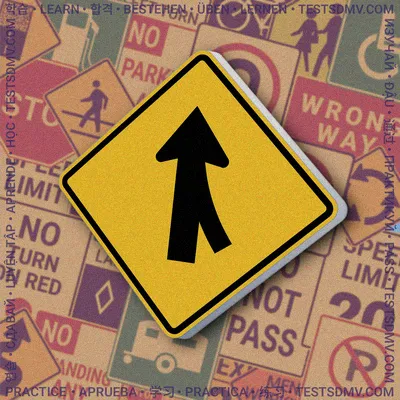
This sign means:
Two separate roadways are joining. Drivers on both roads should adjust speed and position to merge safely.
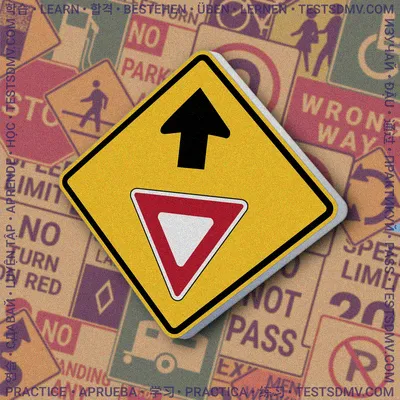
This road sign means:
Be prepared to slow down or stop to yield the right-of-way at the upcoming intersection.

This sign means:
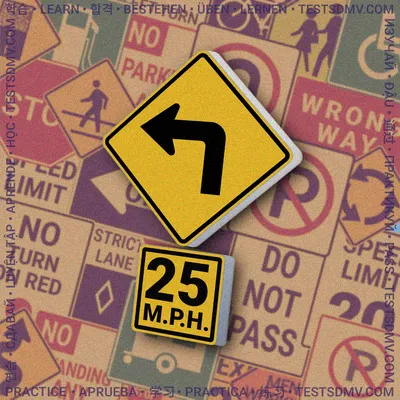
This sign means:
This recommends the maximum safe speed for the sharp turn under ideal conditions.
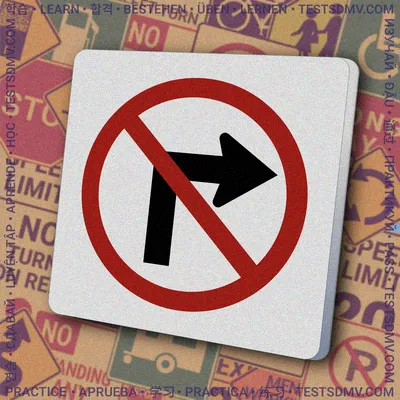
This road sign means:
When is the risk of drowsy driving highest?
These times align with the body's natural circadian rhythm, during which sleepiness and a dip in alertness naturally occur.
Use your horn to:
Never use your horn to express anger, greet friends, or try to make a slow driver move faster.
How should you approach a shared center left-turn lane?
You must not use a shared center turn lane as a regular travel lane, nor drive in it for more than a short distance (usually 200 to 300 feet).
At a roundabout, you must:
Traffic inside the roundabout always has the right-of-way. Vehicles wishing to enter must wait for a safe gap in the circle.


What Topics Do DMV Flashcards Cover?
These flashcards cover five core areas of the DMV written test: traffic laws, road sign recognition (both visual and descriptive), safe driving practices, and alcohol and drug regulations. The set contains 520+ cards, each presenting a question on one side and the answer on the other. Most cards include a brief explanation to reinforce key concepts.
There is no score and no time limit. Tap a card to reveal the answer, then mark it as known or unknown. Cards you mark as unknown return to the end of the deck for another round. After completing all cards, tap “Study remaining” to review only the ones you missed.
This format is useful for targeted review — focus on one category at a time, identify gaps in your knowledge, and revisit weak spots until they stick. Pair flashcards with practice tests to combine active recall with exam-like conditions.
Common Questions
The set includes 520 flashcards divided into five categories: Traffic Laws, Road Signs (Visual), Road Signs (Descriptive), Safe Driving, and Alcohol & Drugs. Each category focuses on a specific area of the DMV written test, and you can study them independently.
Visual cards display a road sign image and ask you to identify its meaning or the action it requires. Descriptive cards present a text-based question about sign rules, colors, or shapes without showing an image. Together, the two sets cover both recognition and regulatory knowledge. For additional sign practice under test conditions, try the Road Signs practice tests.
Most cards include a brief explanation on the answer side to help you understand the reasoning behind the correct response. This makes flashcards useful for learning the material, not just memorizing answers.
Flashcards and practice tests serve different purposes. Flashcards are designed for active recall — quickly identifying what you know and what needs more review. Practice tests simulate exam conditions with a set number of questions and a passing score. Using both gives you a more thorough preparation; for specific test requirements, check your state DMV’s website.
