
Use this guide to prepare for the exam, and refer to the official manual for complete details.
Knowing how to park a vehicle legally and safely is a fundamental skill that affects traffic flow, public safety, and accessibility. These rules are not just for passing the road test; they prevent accidents, ensure emergency vehicles have access, and keep crosswalks clear for pedestrians. Understanding and following parking regulations avoids costly fines and towing fees and demonstrates a driver’s respect for the community.
General Parking Rules
Properly parking a vehicle involves more than just finding an empty space. It requires following specific procedures to ensure the vehicle is secure and positioned correctly according to the law.
Securing the Vehicle
Whenever a driver leaves a vehicle unattended, state law requires them to take specific steps to prevent it from moving or being stolen. The driver must stop the engine, set the parking brake firmly, lock the ignition, and remove the key. It is also required to lock all doors. This sequence ensures the vehicle will not roll away and makes it more difficult to steal.
Parking on a Hill
This is a critical safety maneuver tested on the road exam. The direction the front wheels are turned depends on whether there is a curb and whether the vehicle is facing uphill or downhill. The goal is to use the curb or the edge of the road to stop the vehicle if the brakes fail.
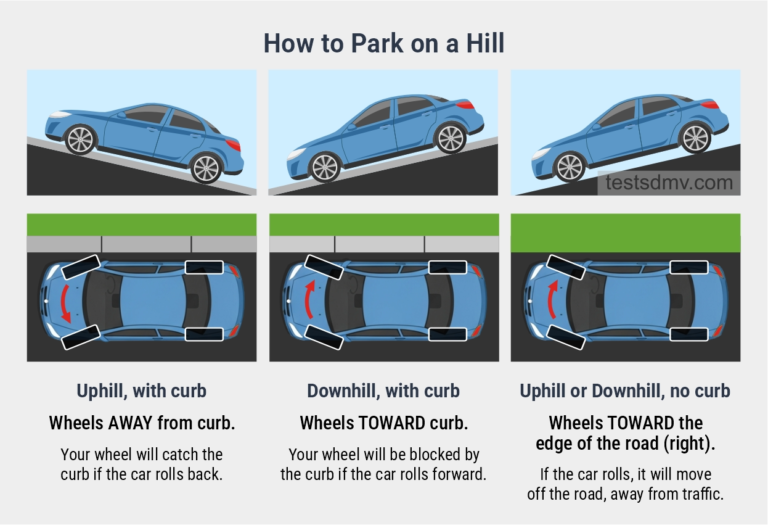
- Uphill, With a Curb: Turn the wheels away from the curb (outward, to the left). If the vehicle starts to roll backward, the back of the front tire will catch the curb, stopping the car.
- Downhill, With a Curb: Turn the wheels toward the curb (inward, to the right). The front of the tire will rest against the curb, preventing the car from rolling into traffic.
- Uphill, No Curb: Turn the wheels toward the edge of the road (inward, to the right). If the vehicle rolls, it will move away from the travel lane and off the road.
- Downhill, No Curb: Turn the wheels toward the edge of the road (inward, to the right), for the same reason as parking uphill without a curb.
Types of Parking
- Parallel Parking: This involves parking the vehicle in line with other parked vehicles, parallel to the curb. In Massachusetts, the vehicle’s wheels must be no more than 12 inches from the curb. Drivers must ensure there is enough space in front of and behind the vehicle for it and other cars to exit the space safely.
- Angle and Perpendicular Parking: Commonly found in parking lots, these spaces are marked with white lines. Drivers must park entirely within the marked lines of a single space. It is illegal to park across multiple spaces.
Pro-Tip:
A simple way to remember how to turn your wheels on a hill is “Up, Up, and Away.” When parking Uphill with a curb, turn your wheels Up and Away from the curb. For all other hill parking scenarios, turn the wheels toward the curb or edge of the road.
🔒
This is Premium content. Get access to restricted content — extended DMV Tests, Study Guides, and CDL exams.
Get Premium AccessAlready purchased? Log in


