
Use this guide to prepare for the exam, and refer to the official manual for complete details.
Beyond knowing the traffic laws, safe driving is a proactive skill that requires constant attention and good judgment. Adopting defensive driving habits—anticipating potential hazards and making safe choices—is the key to avoiding crashes. This chapter covers the essential practices that will not only help you pass the driver’s license exam but will also equip you to handle the complex challenges you will face on the road every day.
Principles of Defensive Driving
Defensive driving means operating your vehicle in a way that saves lives, time, and money, in spite of the conditions around you and the actions of others. It is a proactive mindset focused on awareness and anticipation.
Scanning
Effective scanning involves continuously moving your eyes to keep track of the entire driving environment. A safe driver looks well ahead of their vehicle (about 12-15 seconds, or one city block), checks their rearview and side mirrors every few seconds, and scans for hazards at intersections, crosswalks, and along the sides of the road. This practice helps you see potential problems early, giving you more time to react.
Space Cushions
A space cushion is the safe area of open space you maintain around your vehicle. The most important part of this cushion is the distance between you and the vehicle ahead. Use the 3-4 second rule to maintain a safe following distance:
- Pick a fixed object on the road ahead, like a sign or an overpass.
- When the rear bumper of the vehicle in front of you passes that object, begin counting: “one-thousand-one, one-thousand-two, one-thousand-three.”
- If your front bumper reaches the object before you finish counting, you are following too closely.
You must increase your following distance to four seconds or more in adverse conditions, such as bad weather, when following large trucks (to stay out of their No-Zone), or when being tailgated.
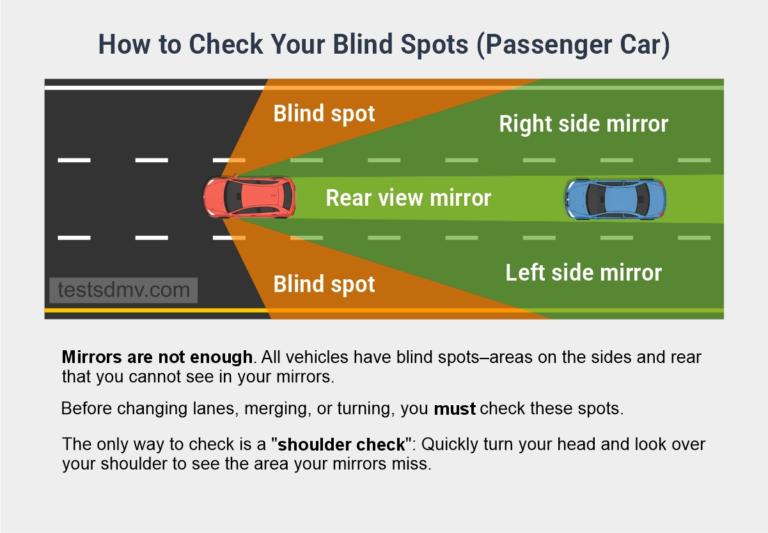
Managing Blind Spots
Blind spots are the areas around your vehicle that cannot be seen in your mirrors. Before changing lanes, merging, or turning, you must physically turn your head to check these areas. This is often called a “head check” or “shoulder check.” Never rely solely on your mirrors. Be aware of the large blind spots, or “No-Zones,” around large trucks and buses on all four sides.
Pro-Tip:
When driving, avoid lingering in another driver’s blind spot. If you can’t see the driver’s face in their side mirror, they likely can’t see you. Adjust your speed to either pull ahead of or drop back from the other vehicle.
🔒
This is Premium content. Get access to restricted content — extended DMV Tests, Study Guides, and CDL exams.
Get Premium AccessAlready purchased? Log in


