Use this guide to prepare for the exam, and refer to the official manual for complete details.
Traffic signs, signals, and pavement markings form the language of the road, providing essential information, warnings, and regulations to every driver. Understanding this system is non-negotiable for safety; it ensures traffic moves in an orderly, predictable fashion and helps prevent crashes at intersections and along roadways. Mastery of this visual language is a primary focus of the knowledge test and a core skill for safe, defensive driving.
Sign Colors and Shapes
The color and shape of a traffic sign provide the first and most important clues about its meaning. A driver can often recognize the message of a sign from a distance, even before reading its text, simply by identifying its shape and color.
Sign Shapes
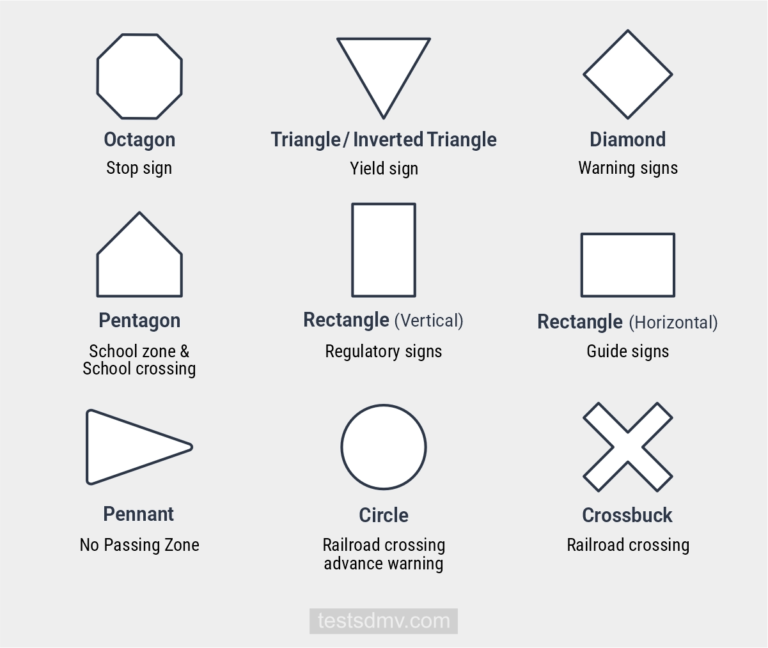
- Octagon (8 sides) — Exclusively for STOP signs. A driver must come to a complete stop before the stop line, crosswalk, or intersection.
- Triangle (inverted) — Exclusively for YIELD signs. A driver must slow down and be prepared to stop, yielding the right-of-way to any vehicles or pedestrians in or approaching the intersection.
- Circle — Exclusively for Railroad Crossing advance warning signs. This round, yellow sign with a black “X” and “RR” indicates a railroad crossing is ahead.
- Pennant (sideways triangle) — Used for NO PASSING ZONE warning signs. This sign is posted on the left side of the road to supplement a solid yellow center line.
- Diamond — Used for warning signs. These signs alert drivers to potential hazards or changes in road conditions ahead, such as a curve, slippery road, or deer crossing.
- Pentagon (5 sides) — Used for School Zone and School Crossing signs. It indicates that children may be present and that a lower speed limit may be in effect.
- Rectangle (vertical) — Generally used for regulatory signs, such as Speed Limit, No Parking, or Keep Right signs.
- Rectangle (horizontal) — Generally used for guide signs, providing information about destinations, routes, and points of interest.
🔒 This is Premium content. Get access to restricted content — extended DMV Tests, Study Guides, and CDL exams.
Get Premium AccessAlready purchased? Log in


