
Use this guide to prepare for the exam, and refer to the official manual for complete details.
Properly parking a vehicle is a critical driving skill that ensures the safety of all road users and protects property. Knowing the rules for where, when, and how to park legally is essential for the driving exam and for avoiding costly fines, towing, or causing a hazardous obstruction. Mastering these regulations, from parking on a steep hill to understanding prohibited zones, demonstrates a driver’s responsibility and awareness.
General Parking Rules
Whenever a driver leaves a vehicle, they must ensure it is properly secured to prevent it from moving. This involves a sequence of simple but critical steps. An improperly parked vehicle can roll into traffic, causing a serious collision.
Securing the Vehicle
- Set the Parking Brake: This is the most important step. The parking brake provides a mechanical lock on the wheels that is separate from the hydraulic brake system.
- Place the Vehicle in Gear: For an automatic transmission, shift the gear selector to “Park.” For a manual transmission, shift into reverse if facing downhill or first gear if facing uphill.
- Turn Off the Engine: Turn the ignition completely off.
- Lock the Ignition and Remove the Key: This prevents theft and unauthorized use of the vehicle.
Parking on a Hill
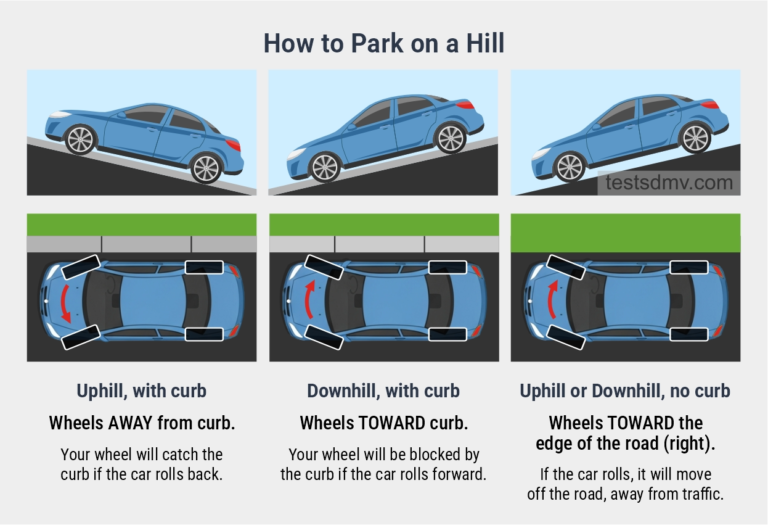
Parking on an incline requires extra precaution. The direction of the front wheels should be turned so that if the vehicle were to roll, it would roll into the curb or away from traffic.
🔒
This is Premium content. Get access to restricted content — extended DMV Tests, Study Guides, and CDL exams.
Get Premium AccessAlready purchased? Log in
