
Use this guide to prepare for the exam, and refer to the official manual for complete details.
Becoming a licensed driver is only the first step; becoming a safe driver is a lifelong commitment. Safe driving practices are proactive strategies that help you anticipate and avoid hazards, rather than just reacting to them. Mastering these defensive driving skills, understanding how to adapt to different conditions, and avoiding dangerous behaviors are essential for protecting yourself and others, and are core components of the driver’s knowledge exam.
Principles of Defensive Driving
Defensive driving means being constantly aware of your surroundings and prepared for the unexpected. It is built on three core principles: scanning, maintaining a space cushion, and managing blind spots.
Scanning
Effective scanning involves keeping your eyes constantly moving to identify potential hazards early. Instead of staring at the road directly in front of your vehicle, you should look far ahead. Good drivers scan 20 to 30 seconds down the road, which allows them to see problems before they become immediate dangers. This includes checking mirrors every 6 to 8 seconds to be aware of traffic to the sides and rear. Continual scanning helps prevent you from becoming fixated on one object and gives you the time needed to react smoothly and safely.
Space Cushions
A space cushion is the area of open space you maintain on all sides of your vehicle. This buffer gives you time and room to react to mistakes made by other drivers. The most important space cushion is the one in front of you. Maine law recommends using the four-second rule to maintain a safe following distance. To check your distance, watch the vehicle ahead of you pass a fixed object, like a sign or a tree. Then, begin counting “one-thousand-one, one-thousand-two, one-thousand-three, one-thousand-four.” If you reach the object before you finish counting, you are following too closely. You must increase your following distance in adverse conditions, when following large trucks or motorcycles, or when being tailgated.
Managing Blind Spots
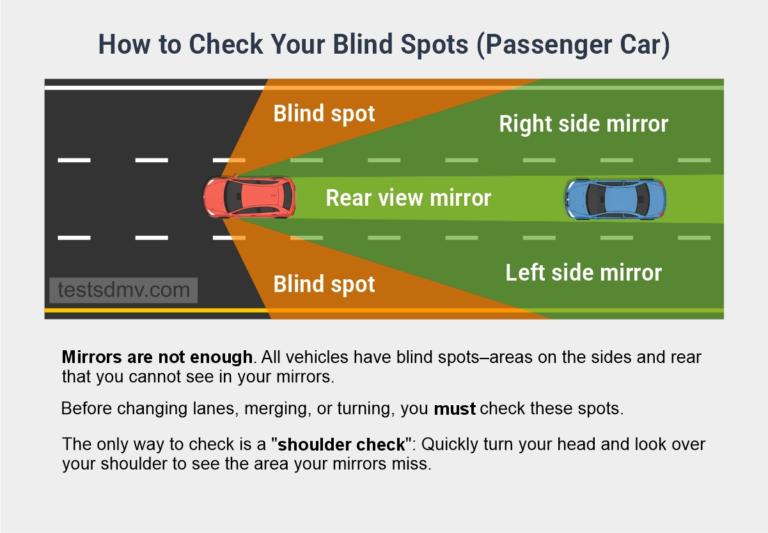
Blind spots are areas around your vehicle that cannot be seen in your mirrors. Every vehicle has them, typically to the sides and slightly to the rear. Before changing lanes, merging, or turning, you must physically turn your head to look over your shoulder to check these areas. Relying only on mirrors is a dangerous mistake. It is equally important to stay out of other drivers’ blind spots, especially those of large trucks, which have massive “No-Zones” on all four sides. If you cannot see the truck driver’s face in their side mirror, they cannot see you.
🔒
This is Premium content. Get access to restricted content — extended DMV Tests, Study Guides, and CDL exams.
Get Premium AccessAlready purchased? Log in
