
Use this guide to prepare for the exam, and refer to the official manual for complete details.
Understanding the language of the road—communicated through signs, signals, and pavement markings—is fundamental to safe driving. These traffic controls provide rules, warnings, and guidance that allow for an orderly and predictable flow of traffic, preventing chaos and collisions. Mastering this visual language is essential for passing the knowledge exam and for making safe, split-second decisions behind the wheel.
Sign Colors and Shapes
The color and shape of a traffic sign provide instant information about its meaning, often before you can even read the words. Recognizing them at a glance is a critical driving skill.
Sign Shapes
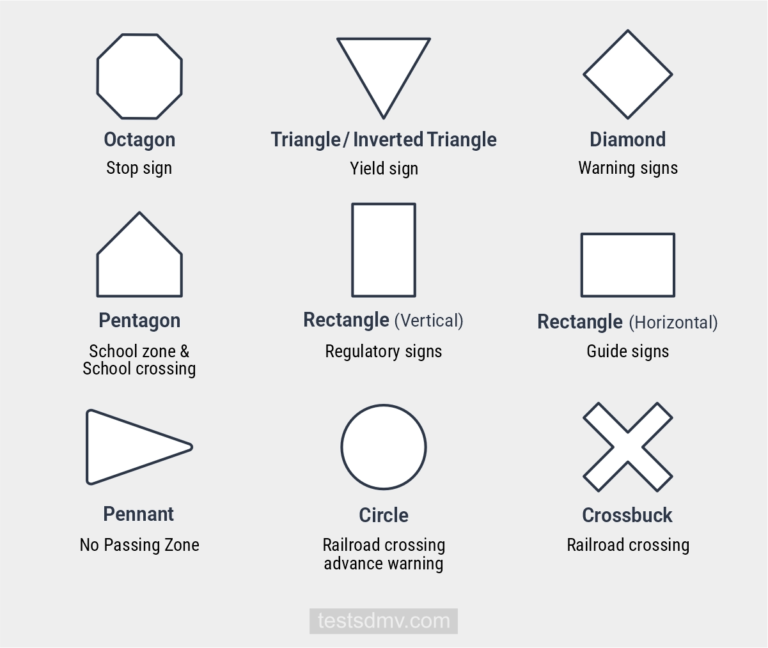
- Octagon (8 sides) — Exclusively for Stop signs.
- Triangle (downward-pointing) — Exclusively for Yield signs.
- Circle — Exclusively for Railroad Advance Warning signs.
- Pennant (sideways triangle) — Used for No Passing Zone warning signs, found on the left side of the road.
- Diamond — Used for general warning signs, alerting you to potential hazards or changes in road conditions ahead.
- Rectangle (vertical) — Generally used for regulatory signs, such as Speed Limit signs.
- Rectangle (horizontal) — Generally used for guide signs, providing directions or information.
- Pentagon (5 sides) — Used for School Zone and School Crossing warning signs.
🔒
This is Premium content. Get access to restricted content — extended DMV Tests, Study Guides, and CDL exams.
Get Premium AccessAlready purchased? Log in
