
Use this guide to prepare for the exam, and refer to the official manual for complete details.
Possessing a driver’s license is only the first step; becoming a safe driver is a lifelong commitment to awareness, judgment, and skill. Safe driving practices, often called defensive driving, are about proactively managing the space around your vehicle and anticipating the actions of others to prevent crashes before they happen. Mastering these techniques is not only crucial for passing the road test but is the key to protecting yourself, your passengers, and everyone else who shares the road.
Principles of Defensive Driving
Defensive driving is a strategy that aims to reduce risk by assuming other drivers may make mistakes. It involves constantly assessing the driving environment and being prepared to react safely to any potential hazard. The core principles are scanning, maintaining a space cushion, and managing blind spots.
Scanning
A defensive driver’s eyes are always moving. You must scan the entire environment, not just stare at the road directly in front of you. Look ahead at least 10 to 12 seconds’ worth of travel time (about one city block at low speeds, or a quarter-mile on the highway). This gives you time to spot hazards early and react smoothly. Your scan should include looking to the sides for vehicles or pedestrians entering your path and checking your mirrors every few seconds to be aware of traffic behind you.
Space Cushions (3-4 Second Rule)
The most effective way to prevent a rear-end collision is to maintain a safe following distance, or space cushion, between your vehicle and the one ahead. Use the 3- to 4-second rule to measure this distance. When the vehicle in front of you passes a fixed object (like a sign or tree), begin counting “one-one-thousand, two-one-thousand, three-one-thousand.” If you reach the object before you finish counting to three, you are following too closely. You should increase your following distance to four seconds or more in adverse conditions, when following large trucks or motorcycles, or when being tailgated.
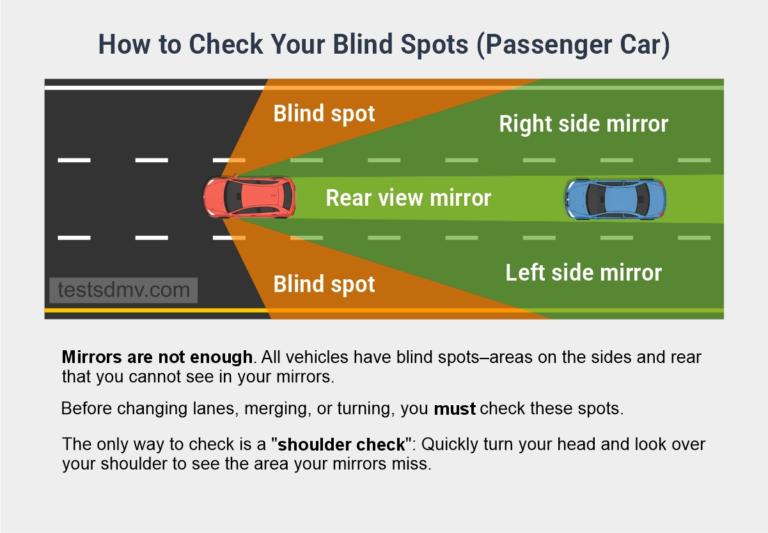
Managing Blind Spots
Every vehicle has blind spots—areas around it that cannot be seen in the mirrors. Before changing lanes, merging, or turning, you must check these areas by quickly looking over your shoulder. Equally important is staying out of other drivers’ blind spots. Avoid lingering alongside another car, and be especially cautious around large trucks, which have massive blind spots (or “No-Zones”) on all four sides.
🔒
This is Premium content. Get access to restricted content — extended DMV Tests, Study Guides, and CDL exams.
Get Premium AccessAlready purchased? Log in


