
Use this guide to prepare for the exam, and refer to the official manual for complete details.
Knowing how to park legally and safely is a fundamental driving skill that is crucial for both the driving test and everyday situations. Improper parking can obstruct traffic, endanger pedestrians and cyclists, and result in expensive fines or towing. Mastering these rules, from correctly positioning your wheels on a hill to understanding curb colors, ensures you can leave your vehicle securely and in compliance with the law.
General Parking Rules
Properly parking a vehicle involves more than just finding a space. It requires a sequence of actions to ensure the vehicle is secure and does not pose a hazard.
Securing the Vehicle
After stopping in a legal parking space, a driver must always:
- Set the parking brake firmly.
- Place the vehicle in “Park” (for automatic transmissions) or in gear (for manual transmissions). For manual vehicles, use first gear if facing uphill and reverse gear if facing downhill.
- Turn off the engine and lock the ignition.
- Remove the key from the ignition.
- Check mirrors and blind spots for traffic, bicyclists, and pedestrians before opening the door. Exit carefully to avoid interfering with others.
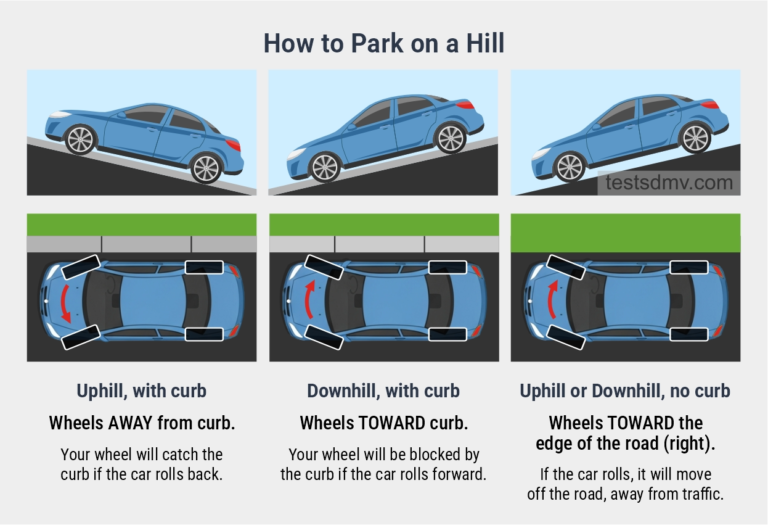
Parking on a Hill
When parking on a slope or hill, the force of gravity creates a risk of the vehicle rolling. To prevent this, a driver must turn the front wheels in a specific direction so that if the brakes fail, the vehicle will roll into the curb or off the road, away from traffic.
🔒
This is Premium content. Get access to restricted content — extended DMV Tests, Study Guides, and CDL exams.
Get Premium AccessAlready purchased? Log in


