
Use this guide to prepare for the exam, and refer to the official manual for complete details.
A driver must be able to instantly recognize and obey traffic signs, signals, and pavement markings. These devices form a visual language that regulates, warns, and guides traffic, and failing to understand them can lead to confusion, traffic violations, and serious crashes. Mastering this language is a non-negotiable part of safe driving and is heavily emphasized on the Alabama driver’s knowledge test.
Sign Colors and Shapes
The color and shape of a traffic sign provide the first and most important clues about its meaning. Recognizing these general categories allows a driver to understand the type of message a sign conveys even from a distance, before the specific words or symbols are readable.
Sign Shapes
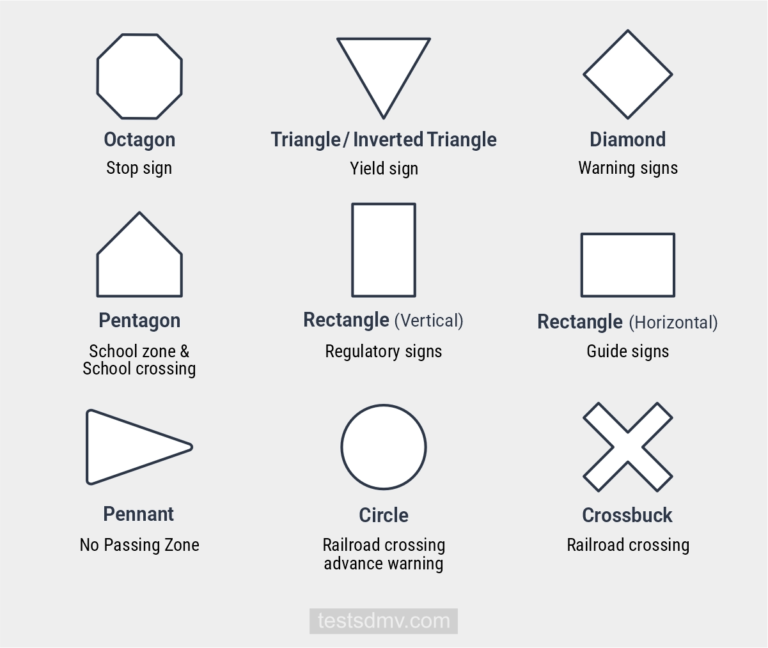
- Octagon (8 sides) — Exclusively for STOP signs. A driver must come to a complete stop before the stop line, crosswalk, or intersection.
- Triangle (inverted) — Exclusively for YIELD signs. A driver must slow down and be prepared to stop, yielding the right-of-way to any vehicles or pedestrians in or approaching the intersection.
- Circle — Exclusively for Railroad Advance Warning signs. This sign, always yellow with a black “X” and “RR,” indicates a railroad crossing is ahead.
- Pennant (sideways triangle) — Used to mark the beginning of a NO PASSING ZONE. This sign is placed on the left side of the road, facing the driver.
- Diamond — Used for WARNING signs. These signs alert drivers to potential hazards or changes in road conditions ahead, such as a curve, slippery surface, or merging traffic.
- Pentagon (5 sides) — Used for SCHOOL ZONE and SCHOOL CROSSING signs. It indicates that children may be present and a lower speed limit may be in effect.
- Rectangle (vertical) — Generally used for REGULATORY signs, such as Speed Limit signs.
- Rectangle (horizontal) — Generally used for GUIDE signs, providing directions, route markers, or information about services.
Sign Colors

- Red — Used for STOP, YIELD, or prohibition signs (e.g., “Do Not Enter,” “Wrong Way”). Red commands immediate action.
- Black and White — Used for REGULATORY signs, which state the law (e.g., Speed Limit, No Turn on Red).
- Yellow — Used for general WARNING signs, alerting drivers to hazards ahead.
- Fluorescent Yellow-Green — Used for school, pedestrian, and bicycle warning signs. This bright color is highly visible.
- Orange — Used for temporary traffic control, indicating a WORK ZONE or construction area ahead. Drivers must be extra cautious.
- Green — Used for GUIDE signs, indicating directions, distances, and highway entrances/exits.
- Blue — Used for GUIDE signs related to motorist services (e.g., gas, food, lodging) and for accessible parking signs.
- Brown — Used for GUIDE signs related to public recreation and scenic or cultural points of interest.
🔒
This is Premium content. Get access to restricted content — extended DMV Tests, Study Guides, and CDL exams.
Get Premium AccessAlready purchased? Log in


