
Use this guide to prepare for the exam, and refer to the official manual for complete details.
Possessing a driver’s license is only the first step; becoming a truly safe driver is a lifelong commitment to awareness and skill. The principles of defensive driving—anticipating hazards, managing space, and staying focused—are the most effective tools for preventing collisions. Mastering these concepts is crucial for the driving test and for ensuring a lifetime of safe travel for you and those you share the road with.
Safe driving is a proactive, not reactive, activity. It involves constantly assessing the driving environment and making small adjustments to avoid dangerous situations before they develop. This includes managing the space around the vehicle, adapting to changing conditions, and maintaining a focused and calm state of mind.
Principles of Defensive Driving
Defensive driving means expecting the unexpected and always having a plan. Three core components are scanning, maintaining a space cushion, and managing blind spots.
Scanning
A safe driver’s eyes are always moving. Instead of staring at the vehicle directly ahead, a driver should be scanning the entire environment. This means looking 10 to 15 seconds down the road to see developing hazards early. It also involves regularly checking the rearview and side mirrors (every 5-8 seconds) to be aware of what is happening behind and beside the vehicle. This constant information gathering allows a driver to anticipate the actions of others and have more time to react.
Space Cushions
A proper space cushion is the most important safety buffer a driver can maintain. The “3-4 second rule” is the standard for measuring a safe following distance in ideal conditions. To measure it, a driver should watch the vehicle ahead pass a fixed object (like a sign or tree), then count “one-thousand-one, one-thousand-two, one-thousand-three.” If the driver’s own vehicle reaches the object before finishing the count, they are following too closely. This distance should be increased to 5-6 seconds or more in bad weather, when being tailgated, or when following large trucks.
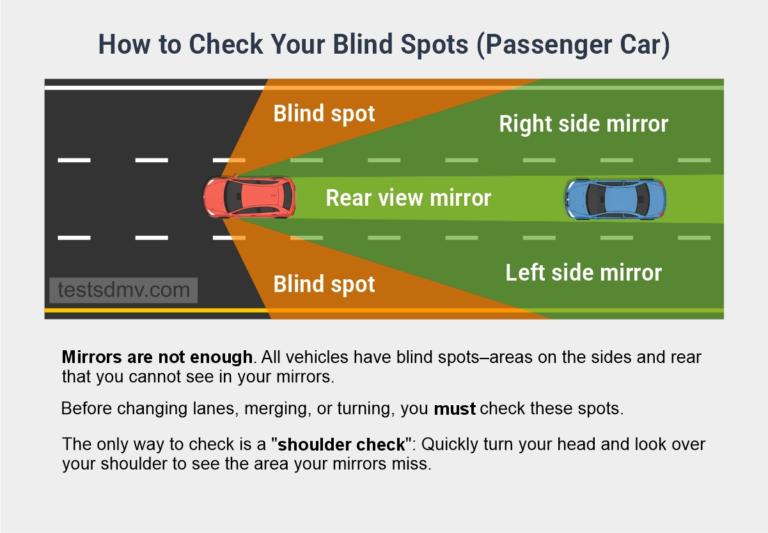
Managing Blind Spots
Blind spots are the areas around a vehicle that cannot be seen in the mirrors. Before every lane change, merge, or turn, a driver must perform a physical head check, looking over their shoulder to see if a vehicle is in their blind spot. Properly adjusted mirrors can help reduce the size of blind spots, but they can never eliminate them completely.
🔒
This is Premium content. Get access to restricted content — extended DMV Tests, Study Guides, and CDL exams.
Get Premium AccessAlready purchased? Log in


