
Use this guide to prepare for the exam, and refer to the official manual for complete details.
Knowing traffic laws is only half the battle; applying safe driving habits every moment behind the wheel is what truly prevents crashes. This chapter focuses on the defensive driving techniques and behaviors that allow a driver to anticipate hazards, manage space, and adapt to challenging conditions. Mastering these practices is essential for lifelong safety and for demonstrating the competence required to pass the driver’s license examination.
Safe driving is an active, continuous process of observing, anticipating, and acting. It goes beyond simply following the rules and involves developing a defensive mindset that prioritizes safety above all else. This includes managing the space around the vehicle, adjusting to different road and weather conditions, and maintaining full, unimpaired focus on the driving task.
Principles of Defensive Driving
Defensive driving means expecting the unexpected and being prepared to react safely to the mistakes of others. The core principles are visibility, space management, and communication.
Scanning and Awareness
A safe driver constantly scans their entire environment, not just the road directly ahead. This involves keeping your eyes moving to see the big picture. Look ahead, to the sides, and behind your vehicle. In the city, you should be looking at least one block ahead. On the highway, you should look at least a quarter of a mile ahead. This practice gives you time to spot potential hazards like brake lights, swerving vehicles, or children playing near the road, allowing you to react smoothly and avoid panic stops.
Space Cushions
Maintaining a safe following distance, or a “space cushion,” around your vehicle is the single best way to avoid a collision.
Following Distance (Three-Second Rule)
The most effective way to measure a safe following distance is the “three-second rule.” Choose a fixed object on the road ahead, like a sign or an overpass. When the vehicle in front of you passes that object, begin counting “one-thousand-one, one-thousand-two, one-thousand-three.” If you reach the object before you finish counting, you are following too closely. You should increase this distance to four or more seconds in bad weather, when following large trucks, or when being tailgated.
Space to the Sides
Avoid driving directly next to other vehicles on multi-lane roads. This creates a side cushion, giving you an escape path if another driver swerves into your lane. Stagger your position relative to cars in adjacent lanes.
Managing Blind Spots
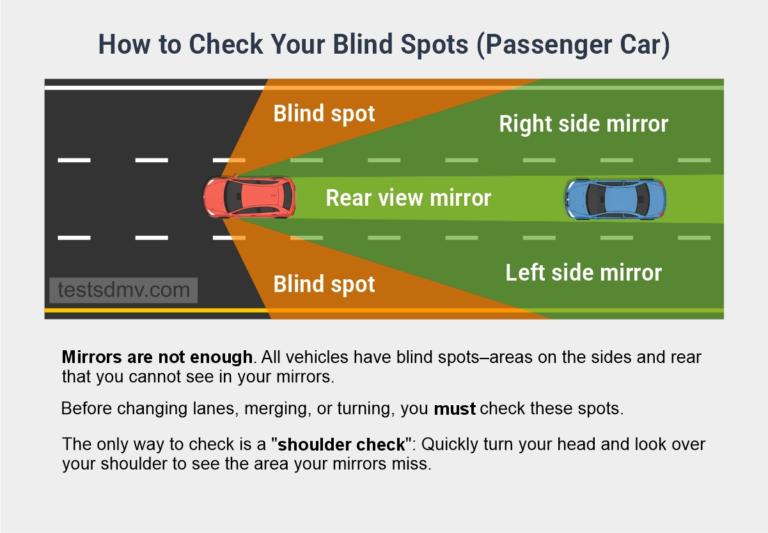
Every vehicle has blind spots—areas to the sides and rear that cannot be seen in the mirrors. Before changing lanes, turning, or merging, you must physically turn your head and look over your shoulder to check these areas. Equally important is to avoid lingering in another driver’s blind spot, especially the large “No-Zones” around trucks and buses.
Pro-Tip:
If a driver is following you too closely (tailgating), don’t slam on your brakes. Instead, slowly reduce your speed to encourage them to pass you. If possible and safe, move to another lane. Increasing your own following distance from the car ahead of you will give you more time to brake gradually if needed, reducing the risk of the tailgater hitting you.
🔒
This is Premium content. Get access to restricted content — extended DMV Tests, Study Guides, and CDL exams.
Get Premium AccessAlready purchased? Log in


