
Use this guide to prepare for the exam, and refer to the official manual for complete details.
The language of the road is communicated through signs, signals, and pavement markings. Understanding this universal system is essential for navigating safely and legally, as it provides warnings, regulations, and guidance. A driver’s ability to instantly recognize and obey these traffic controls is a core component of safe driving and is heavily tested on the written driver’s license exam.
Sign Colors and Shapes
The shape and color of a traffic sign provide instant information about its meaning, often before a driver can even read the words. This system is designed for quick recognition, which is critical at driving speeds and in poor weather conditions.
Sign Shapes
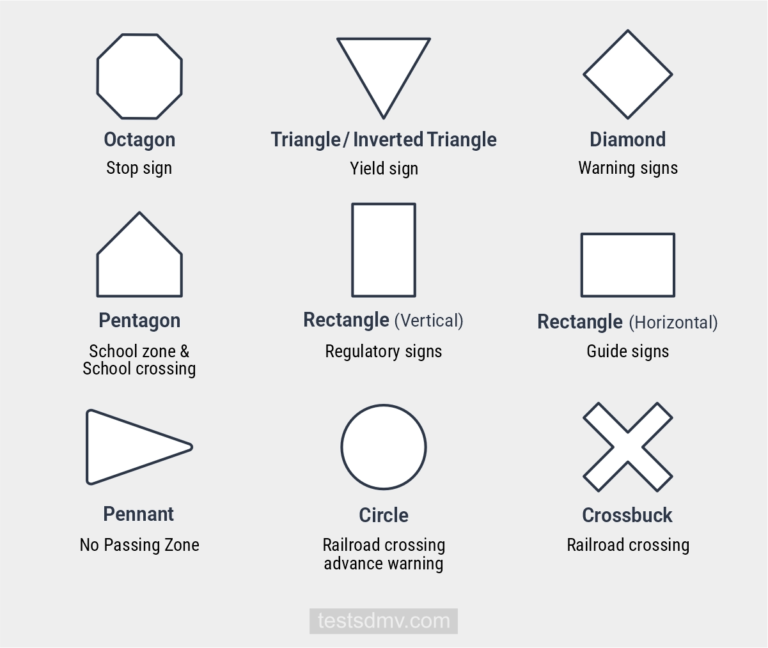
- Octagon (8 sides) — Exclusively for stop signs. A driver must come to a complete stop before the stop line, crosswalk, or intersection.
- Triangle (inverted) — Exclusively for yield signs. A driver must slow down and be prepared to stop, yielding the right-of-way to traffic and pedestrians.
- Circle — Advance warning of a railroad crossing ahead.
- Pennant (sideways triangle) — Marks the beginning of a no-passing zone. This sign is placed on the left side of the road.
- Pentagon (5 sides) — Indicates a school zone or school crossing ahead.
- Diamond — Warns of an existing or potential hazard on or near the roadway (e.g., curve, crossroad, slippery surface).
- Rectangle (vertical) — Generally used for regulatory signs, such as speed limits.
- Rectangle (horizontal) — Generally used for guide signs, providing directions or information.
Sign Colors

- Red — Used for stop, yield, and prohibition signs (e.g., “Do Not Enter,” “Wrong Way”). It conveys the need for immediate driver action.
- Black and White — Used for regulatory signs, which state the law (e.g., speed limits, “No Turn on Red”).
- Yellow — Used for general warning signs to alert drivers to hazards or changing road conditions.
- Yellow-Green — Used for pedestrian, bicycle, and school warning signs. This color is brighter and more visible than standard yellow.
- Orange — Used for temporary traffic control, indicating construction or maintenance zones.
- Green — Used for guide signs, providing directional information such as street names, destinations, and mileage.
- Blue — Used for motorist service signs, indicating the location of services like gas, food, lodging, and hospitals.
- Brown — Used for public recreation and scenic guidance signs, indicating parks, historical sites, and recreational areas.
🔒
This is Premium content. Get access to restricted content — extended DMV Tests, Study Guides, and CDL exams.
Get Premium AccessAlready purchased? Log in


