
Use this guide to prepare for the exam, and refer to the official manual for complete details.
Becoming a licensed driver is only the first step; becoming a safe driver is a lifelong commitment to awareness and skill. Safe driving practices are the foundation of accident prevention, focusing on how to anticipate hazards, manage the space around your vehicle, and adapt to changing conditions. Mastering these defensive driving techniques is essential not only for passing the road test but for protecting your life and the lives of others every time you get behind the wheel.
Safe driving is a proactive mindset, not a reactive one. It involves actively looking for potential dangers, making decisions that minimize risk, and controlling your vehicle in a way that accounts for the unpredictable actions of others and the challenges of the environment. Adopting these practices reduces the likelihood of being involved in a collision.
Principles of Defensive Driving
Defensive driving means operating your vehicle in a way that saves lives, time, and money, in spite of the conditions around you and the actions of others. It is built on the principles of awareness, space management, and clear communication.
Scanning
The single biggest contributor to crashes is a driver’s failure to see what is happening. Effective scanning means constantly moving your eyes to look ahead, to the sides, and behind your vehicle. You should look down the road at least 10-15 seconds ahead of your vehicle. In the city, this is about one block; on the highway, it’s about a quarter of a mile. This gives you time to spot hazards early and react smoothly instead of panicking at the last moment.
Space Cushions
A driver’s best defense is distance. Maintaining a safe “space cushion” around all sides of your vehicle gives you room to maneuver or stop in an emergency. The most important cushion is the one in front of you. Use the Three-Second Rule to maintain a safe following distance. Watch the vehicle ahead of you pass a fixed object, like a sign or a tree. Then, count “one-one-thousand, two-one-thousand, three-one-thousand.” If you reach the object before you finish counting, you are following too closely. In poor weather or when following large trucks, increase this to a four-second or even five-second following distance.
Managing Blind Spots
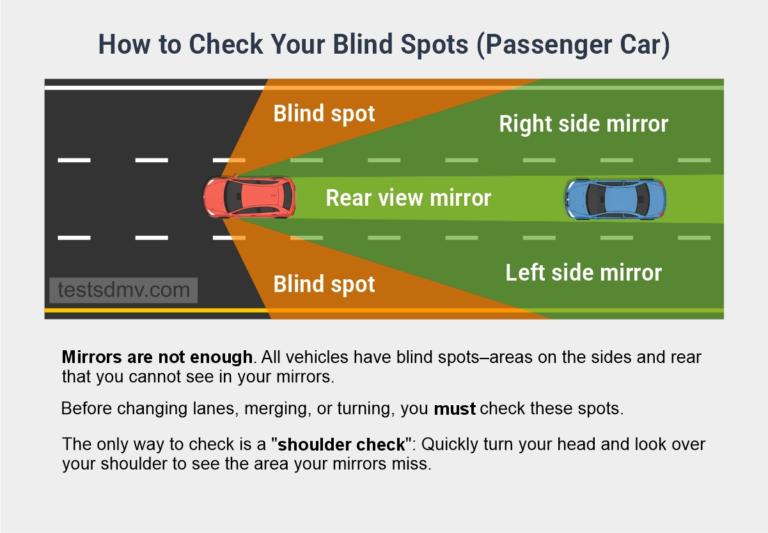
Every vehicle has “no-zones” or blind spots—areas around the vehicle that cannot be seen in the mirrors. Before changing lanes, turning, or merging, you must physically turn your head and look over your shoulder to check these areas. Do not rely solely on your mirrors. Likewise, avoid driving in other vehicles’ blind spots, especially those of large trucks and buses. If you can’t see the truck driver in their side mirror, they cannot see you.
Pro-Tip:
When driving in bad weather, increase your following distance from three seconds to at least four or five seconds. This simple adjustment provides the extra time and distance your vehicle will need to stop on a slippery surface.
🔒
This is Premium content. Get access to restricted content — extended DMV Tests, Study Guides, and CDL exams.
Get Premium AccessAlready purchased? Log in

