
Use this guide to prepare for the exam, and refer to the official manual for complete details.
Knowing how to park a vehicle legally and safely is a fundamental driving skill that ensures order and accessibility on public roads. Proper parking prevents obstruction of traffic flow, keeps critical areas like fire hydrants and crosswalks clear for emergency and public use, and avoids damage to vehicles. Mastering these rules is necessary for passing the driving skills test and for being a considerate and lawful member of the driving community.
General Parking Rules
Whenever a driver leaves a vehicle, they must ensure it is properly secured to prevent it from moving. This involves setting the emergency brake, placing the vehicle in “Park” (for automatic transmissions) or in gear (for manual transmissions), turning off the engine, removing the key, and locking the doors.
Parking on a hill requires specific steps to ensure the vehicle will not roll into traffic if the brakes fail. The direction you turn your front wheels depends on whether there is a curb and which way the vehicle is facing.
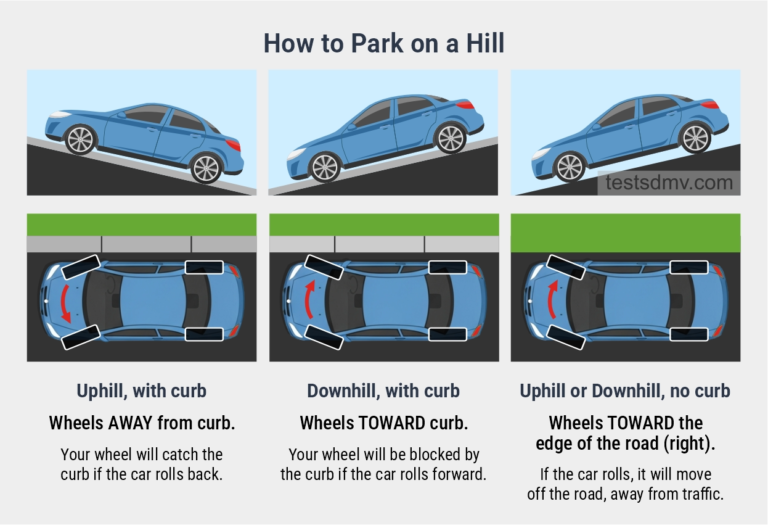
- Downhill with a Curb: Turn your front wheels toward the curb. The curb will act as a block.
- Uphill with a Curb: Turn your front wheels away from the curb. Let the vehicle roll back gently until the back of the front tire touches the curb, which will act as a block.
- Downhill without a Curb: Turn your front wheels toward the side of the road (the right). If the car rolls, it will move off the roadway rather than into traffic.
- Uphill without a Curb: Turn your front wheels toward the side of the road (the right). If the car rolls backward, the front of the car will swing off the roadway.
Pro-Tip:
A simple way to remember which way to turn your wheels when parking uphill with a curb is “Up, Up, and Away.” Turn the wheels up the hill and away from the curb. For all other situations, turn the wheels toward the nearest edge of the road.
🔒
This is Premium content. Get access to restricted content — extended DMV Tests, Study Guides, and CDL exams.
Get Premium AccessAlready purchased? Log in
