Use this guide to prepare for the exam, and refer to the official manual for complete details.
Properly parking a vehicle is a fundamental aspect of driver responsibility that ensures safety and traffic flow. Knowing where, when, and how to park legally prevents collisions, protects pedestrians, and guarantees access for emergency vehicles. Mastering these rules is essential for the driving test and for avoiding costly fines, towing fees, and hazardous situations in daily driving.
General Parking Rules
Parking is more than just stopping the car; it involves a sequence of actions to ensure the vehicle is safe and secure. Whenever a driver leaves a vehicle, they must follow the correct procedure. First, place the gear selector in “Park” (for an automatic transmission) or in gear (for a manual transmission). Second, set the parking brake firmly. Third, turn off the engine and remove the key. Finally, lock the doors to prevent theft.
Parking on a Hill
Gravity can cause a vehicle to roll if not parked correctly on an incline. The direction you turn your front wheels depends on whether there is a curb and whether you are facing uphill or downhill. The goal is always to ensure that if the vehicle’s brakes fail, it will roll into the curb or away from traffic.
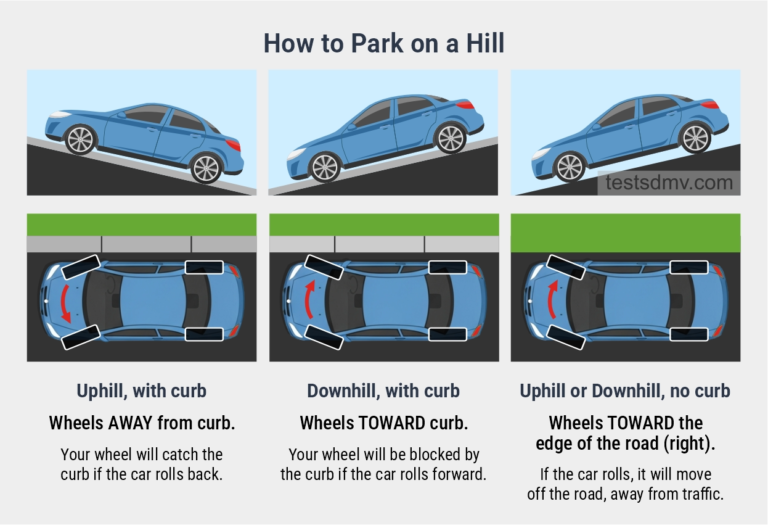
- Downhill with a Curb: Turn your front wheels toward the curb. The curb will act as a block, stopping the car from rolling into the street.
- Uphill with a Curb: Turn your front wheels away from the curb. If the car rolls backward, the back of the front tire will catch the curb, stopping the vehicle.
- Downhill without a Curb: Turn your front wheels toward the right side of the road (the shoulder). The vehicle will roll off the roadway rather than into the path of traffic.
- Uphill without a Curb: Turn your front wheels toward the right side of the road (the shoulder). If the car rolls backward, it will move off the pavement and away from traffic.
🔒 This is Premium content. Get access to restricted content — extended DMV Tests, Study Guides, and CDL exams.
Get Premium AccessAlready purchased? Log in


