
Use this guide to prepare for the exam, and refer to the official manual for complete details.
Adopting safe driving habits is the most effective way to prevent collisions and ensure you arrive at your destination safely. These practices, often called defensive driving, are about more than just following the law; they involve anticipating potential hazards, managing the space around your vehicle, and staying focused on the complex task of driving. Mastering these skills is not only crucial for passing your driving exam but is the key to a lifetime of safe, confident, and collision-free driving.
Principles of Defensive Driving
Defensive driving is a proactive approach where you make decisions that prevent dangerous situations from developing. It involves constantly assessing your surroundings and anticipating the actions of other road users.
Defensive driving is a proactive approach where you make decisions that prevent dangerous situations from developing. It involves constantly assessing your surroundings and anticipating the actions of other road users.
Scanning
Effective scanning means you are constantly aware of the entire traffic scene. You should look down the road at least 10 to 15 seconds ahead of your vehicle. In the city, this is about one block; on the highway, it’s about a quarter of a mile. This gives you time to see and react to hazards like stopped traffic or pedestrians. Scanning also involves checking your rearview and side mirrors every 5 to 8 seconds to know what is happening behind and beside you.
Space Cushions
A space cushion is the safe area you maintain around your vehicle. The most important part of this is your following distance. Use the 3- to 4-second rule to maintain a safe distance from the vehicle ahead. Watch the vehicle in front of you pass a fixed object (like a sign or a tree), then begin counting “one-thousand-one, one-thousand-two, one-thousand-three.” If you reach the object before you finish counting, you are following too closely. Increase this to 4 seconds or more in bad weather, at night, or when following large trucks.
Managing Blind Spots
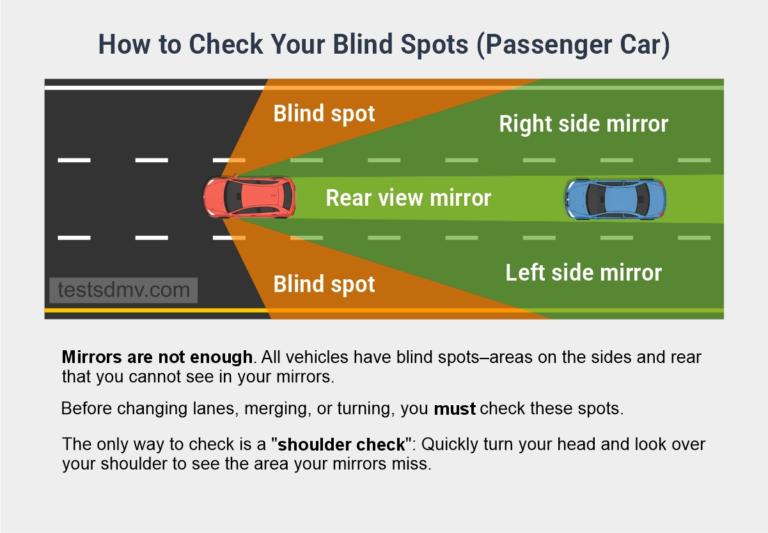
Blind spots are the areas to the sides and rear of your vehicle that are not visible in your mirrors. Before changing lanes, turning, or merging, you must physically turn your head and look over your shoulder to check these areas. Relying only on your mirrors can lead to a collision with a vehicle you did not see. Be aware of the large blind spots, or “No-Zones,” around large trucks and buses.
🔒
This is Premium content. Get access to restricted content — extended DMV Tests, Study Guides, and CDL exams.
Get Premium AccessAlready purchased? Log in
