
Use this guide to prepare for the exam, and refer to the official manual for complete details.
Knowing where and how to legally park a vehicle is a fundamental aspect of safe and responsible driving. Improperly parked vehicles can create serious hazards by obstructing traffic, blocking visibility for other drivers and pedestrians, and impeding emergency services. Mastering these rules is essential for passing the driving exam, avoiding costly fines and towing, and ensuring the safety and convenience of the entire community.
General Parking Rules
Whenever a driver leaves a vehicle, it must be properly secured to prevent it from moving. This involves turning off the engine, setting the parking brake firmly, and removing the key from the ignition. It is also illegal to leave a vehicle unattended without first locking the ignition.
Parking on a Hill
Gravity makes parking on a hill a special situation that requires extra precautions. The direction you turn your front wheels depends on whether there is a curb and whether you are facing uphill or downhill. The goal is always to ensure that if the vehicle’s brakes fail, it will roll away from traffic or into the curb.
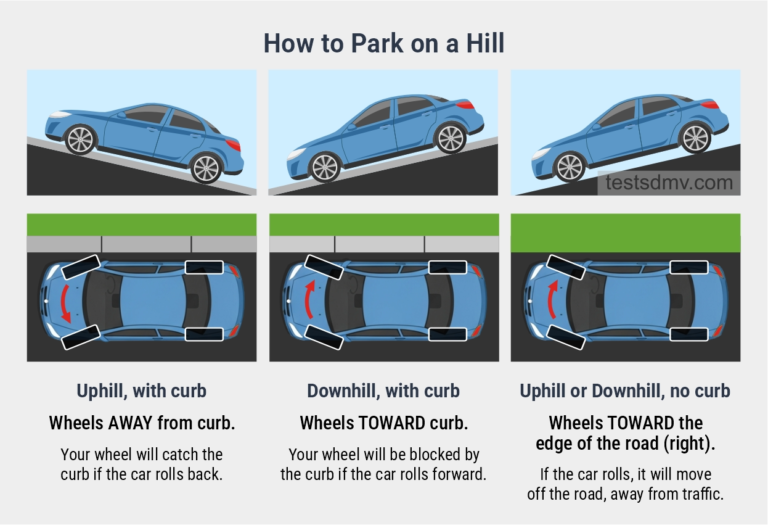
- Uphill with a Curb: Turn your wheels to the left, away from the curb. If the car starts to roll backward, the back of the front tire will catch the curb, stopping the vehicle. A simple way to remember this is “Up, Up, and Away” from the curb.
- Uphill without a Curb: Turn your wheels to the right, toward the shoulder of the road. If the car rolls, it will move off the pavement and away from traffic.
- Downhill with a Curb: Turn your wheels to the right, toward the curb. The front of the tire will rest against the curb, using it as a block.
- Downhill without a Curb: Turn your wheels to the right, toward the shoulder of the road. This ensures the vehicle will roll away from the center of the road if it moves.
Types of Parking
- Parallel Parking: This is parking parallel to the curb. In Texas, a vehicle must be parked with the right-hand wheels within 18 inches of the right-hand curb or edge of the roadway. On a one-way street, a vehicle may be parked parallel to and within 18 inches of the left-hand curb.
- Angle Parking: This involves parking at an angle to the curb, typically in designated spaces in parking lots or on some streets.
- Perpendicular Parking: This is parking at a 90-degree angle to the curb, common in parking lots.
Pro-Tip:
When parallel parking, a good rule of thumb is to stop when your vehicle is even with the car in front of the space, about two feet away from it. Then, turn your wheels sharply to the right and back up until your front seat is aligned with the rear bumper of the car ahead before turning the wheel left to straighten out.
🔒
This is Premium content. Get access to restricted content — extended DMV Tests, Study Guides, and CDL exams.
Get Premium AccessAlready purchased? Log in


