
Use this guide to prepare for the exam, and refer to the official manual for complete details.
Knowing the rules of the road is only half the battle; applying them with a safe, defensive mindset is what prevents crashes. Safe driving practices are about actively anticipating and responding to potential hazards, managing the space around your vehicle, and adapting to changing conditions. Mastering these defensive skills is crucial for passing the driving test and, more importantly, for ensuring you and others get to your destinations safely every day.
Safe driving in Idaho goes beyond simply following speed limits and traffic signals. It involves a proactive approach known as defensive driving, which includes constantly scanning the environment, maintaining a safe space cushion, and being aware of blind spots. It also requires adapting your driving to challenging conditions like night, rain, or snow, and consciously avoiding dangerous behaviors like distracted, fatigued, or aggressive driving.
Principles of Defensive Driving
Defensive driving means driving to save lives, time, and money, in spite of the conditions around you and the actions of others. It is a strategy of anticipating hazards and making adjustments before a dangerous situation develops.
Scanning
Effective scanning is the key to seeing and avoiding trouble. A defensive driver’s eyes are always moving. They look ahead, to the sides, and behind the vehicle to get the complete traffic picture. This includes looking 10 to 15 seconds down the road, which is about one city block, to see developing situations early. When approaching intersections, a driver should look left, then right, then left again before proceeding. This constant awareness helps a driver spot potential hazards like children playing, cars pulling out from side streets, or sudden stops in traffic ahead.
Space Cushions
A space cushion is the safe area of open space maintained around a vehicle. It gives a driver time to react to emergencies. The most important space cushion is the one in front. To maintain a safe following distance, use the three-second rule. Pick a fixed object on the road ahead (like a sign or an overpass). When the vehicle in front of you passes that object, begin counting “one-thousand-one, one-thousand-two, one-thousand-three.” If you pass the object before you finish counting, you are following too closely. This distance should be increased to four seconds or more in bad weather, at night, when following large trucks, or when being tailgated.
Managing Blind Spots
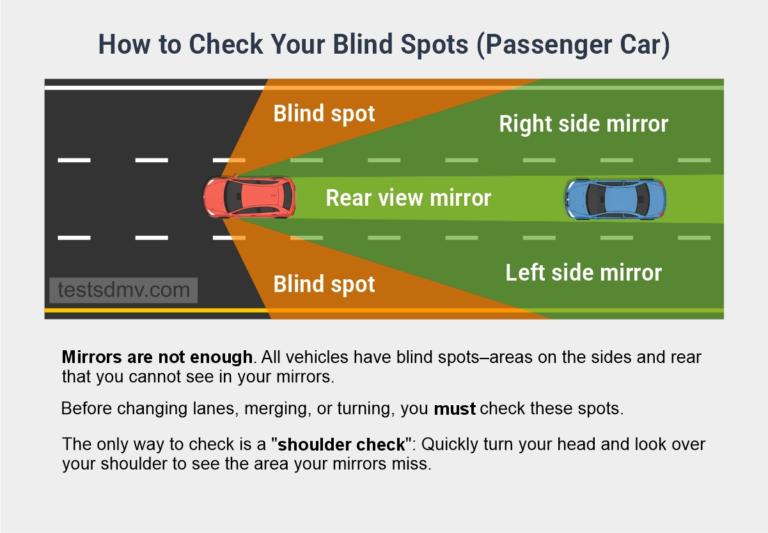
Blind spots are the areas around a vehicle that cannot be seen in the mirrors. Before changing lanes, turning, or merging, a driver must physically turn their head to look over their shoulder to check these areas. Relying only on mirrors is a dangerous mistake. It is equally important to stay out of other drivers’ blind spots, especially those of large trucks and buses (their “No-Zones”). Avoid lingering alongside other vehicles; either speed up or slow down to remain visible.
🔒
This is Premium content. Get access to restricted content — extended DMV Tests, Study Guides, and CDL exams.
Get Premium AccessAlready purchased? Log in


