
Use this guide to prepare for the exam, and refer to the official manual for complete details.
Passing the driver’s test requires knowing the rules, but becoming a safe driver for life requires putting those rules into practice. Safe driving is a proactive skill that involves anticipating hazards, managing the space around your vehicle, and making responsible decisions behind the wheel. Mastering these defensive driving techniques will not only help you avoid collisions but will also build the confidence needed to handle any situation the road presents.
This section focuses on the practical skills and behaviors that form the foundation of safe driving. It covers the principles of defensive driving, how to adapt to hazardous conditions, and the critical importance of avoiding dangerous behaviors like distracted, drowsy, or aggressive driving.
Principles of Defensive Driving
Defensive driving means being constantly aware of your surroundings and anticipating potential dangers before they happen. It is a mindset of vigilance and caution that goes beyond simply following traffic laws.
Scanning
Effective scanning is the habit of continuously moving your eyes to keep track of the entire driving environment. This includes looking well down the road (12-15 seconds ahead), checking your rearview and side-view mirrors every few seconds, and being aware of what is happening to the sides of your vehicle. Avoid staring at a single point; keep your eyes moving to detect potential hazards early.
Space Cushions
A space cushion is the safe area of open space maintained around your vehicle. This gives you the time and space needed to react to sudden stops or swerving vehicles. The most important space cushion is the one in front of you. Use the three-second rule to maintain a safe following distance. To do this, watch the vehicle ahead of you pass a fixed object, like a sign or a tree. Then, begin counting “one-thousand-one, one-thousand-two, one-thousand-three.” If you reach the object before you finish counting, you are following too closely. In bad weather or poor visibility, this distance should be increased to four or five seconds.
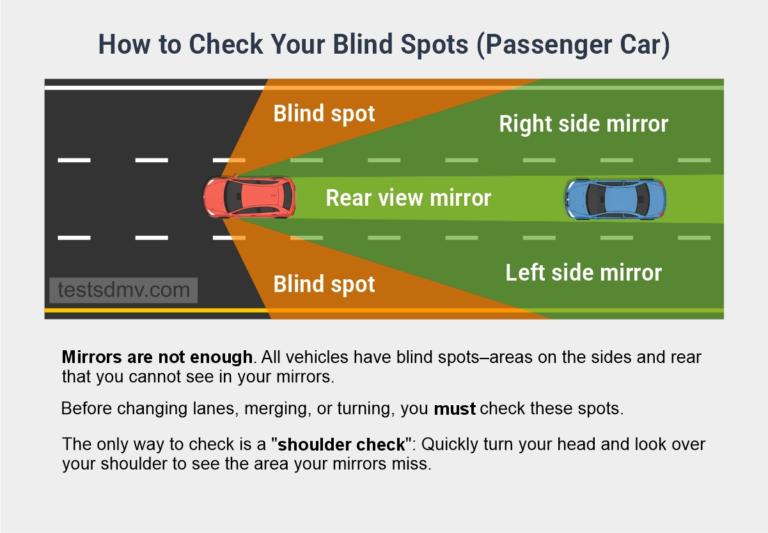
Managing Blind Spots
Blind spots are the areas around your vehicle that cannot be seen in your mirrors. Before changing lanes, turning, or merging, you must physically turn your head and look over your shoulder to check these areas. Relying only on your mirrors leaves you vulnerable to colliding with a vehicle you did not see.
Pro-Tip:
When driving next to a large truck, be aware of their “No-Zones.” These are massive blind spots in front, behind, and on both sides of the truck. If you cannot see the truck driver in their side-view mirror, they cannot see you.
🔒 This is Premium content. Get access to restricted content — extended DMV Tests, Study Guides, and CDL exams.
Get Premium AccessAlready purchased? Log in

