
Use this guide to prepare for the exam, and refer to the official manual for complete details.
Traffic signs, signals, and pavement markings form a universal language that communicates rules, warnings, and guidance to drivers. Understanding this language is non-negotiable for safety and is a major focus of the driver’s knowledge test. Recognizing these symbols instantly allows drivers to anticipate road conditions and the actions of others, preventing confusion and life-threatening crashes.
This section details the meanings of the various shapes, colors, and symbols used on Minnesota’s roadways to regulate, warn, and guide the flow of traffic.
Sign Colors and Shapes
The color and shape of a traffic sign provide the first and most important clues about its meaning, often allowing a driver to understand the message from a distance, even before reading any text.
Sign Shapes
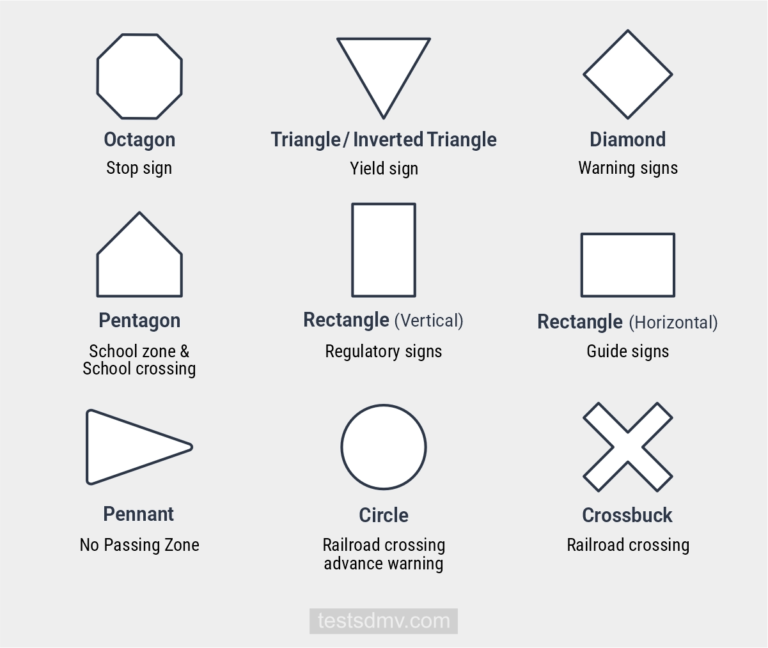
- Octagon (8 sides) — Exclusively for Stop signs. Its unique shape ensures it is recognizable even if covered by snow or dirt.
- Triangle (point down) — Exclusively for Yield signs. It requires drivers to slow down or stop and give the right-of-way to other traffic.
- Circle — Exclusively for Railroad Crossing advance warning signs. This sign, always yellow with a black “X” and “RR,” indicates a crossing is ahead.
- Pentagon (5 sides) — Used for School Zone and School Crossing signs. Its shape is meant to stand out to alert drivers to the presence of children.
- Diamond — Used for Warning signs. These signs alert drivers to potential hazards or changes in road conditions ahead, such as curves, slippery surfaces, or merging traffic.
- Rectangle (vertical) — Generally used for Regulatory signs, such as Speed Limit signs.
- Rectangle (horizontal) — Generally used for Guide signs, providing directions, destinations, and motorist services.
- Crossbuck (X shape) — Marks the actual location of a railroad crossing. A sign below the crossbuck indicates the number of tracks.
🔒
This is Premium content. Get access to restricted content — extended DMV Tests, Study Guides, and CDL exams.
Get Premium AccessAlready purchased? Log in
