
Use this guide to prepare for the exam, and refer to the official manual for complete details.
Properly parking a vehicle is a fundamental driving skill that ensures safety, maintains traffic flow, and respects the needs of other road users. Knowing where, when, and how to park legally is essential for avoiding costly fines, towing, and dangerous situations for pedestrians and other drivers. This information is a key component of the driver’s knowledge test and a daily requirement for responsible driving.
Parking involves more than just stopping the car and getting out. Montana law specifies detailed rules for securing a vehicle, parking on hills, and places where parking is always prohibited. These regulations are designed to prevent runaway vehicles, maintain clear access for emergency services, and ensure visibility at intersections and crosswalks.
General Parking Rules
Whenever a driver parks a vehicle, they must ensure it is secured and positioned correctly to prevent it from becoming a hazard.
Securing the Vehicle
Before leaving a parked vehicle, a driver must always set the parking brake firmly. For vehicles with an automatic transmission, the gear selector should be placed in “Park.” For vehicles with a manual transmission, the gear should be left in reverse (if facing downhill) or first gear (if facing uphill). The driver should turn off the engine, remove the key, and lock the doors.
Parking on a Hill
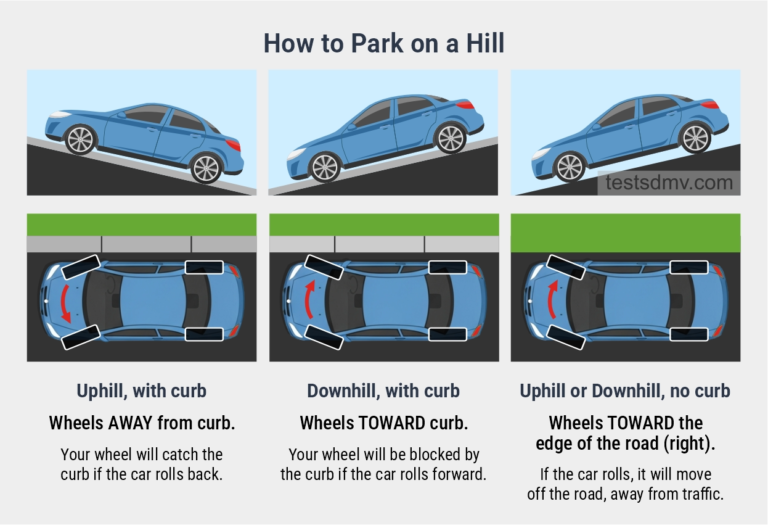
The direction of the front wheels is critical when parking on a grade to prevent the vehicle from rolling into traffic if the brakes fail. There are four scenarios:
- Downhill with a curb: Turn the front wheels toward the curb. The curb will act as a block.
- Uphill with a curb: Turn the front wheels away from the curb. If the car rolls backward, the back of the front tire will hit the curb.
- Downhill without a curb: Turn the front wheels toward the edge of the road (the shoulder). The vehicle will roll away from the travel lane.
- Uphill without a curb: Turn the front wheels toward the edge of the road (the shoulder). The vehicle will roll backward but away from the travel lane.
Types of Parking
Drivers will encounter several types of parking spaces. In all cases, the vehicle must be centered within the marked lines.
- Parallel Parking: Parking parallel to the curb. The vehicle’s wheels must be within 18 inches of the curb.
- Angle Parking: Parking at an angle to the curb, common in parking lots and on some city streets.
- Perpendicular Parking: Parking at a 90-degree angle to the curb or wall, also common in parking lots.
🔒 This is Premium content. Get access to restricted content — extended DMV Tests, Cheat Sheets, and CDL exams.
Get Premium AccessAlready purchased? Log in

